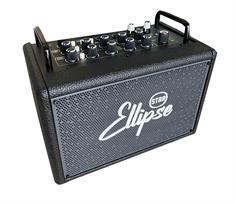
Speakers

There are different types of speakers. Active speakers have a built-in amplifier, which is also called a combo speaker. Passive speakers do not have a built-in amplifier and therefore require an external amplifier or a mixer to function. Many amplifiers run on 220v from your wall socket, but several also run on rechargeable batteries, which gives great flexibility.

Leslie 3500 Amplifier Speaker 300W
200751

Leslie 3500 Amplifier Speaker 300W

The vintage Leslie sound has never been closer.
Read more...
Price at 1 Pcs. - perPcs.:
29.963,00  DKK
Not in stock. Shipping within 3-5 days
Leslie 3500W Amplifier Speaker 300W
200752

Leslie 3500W Amplifier Speaker 300W

The vintage Leslie sound has never been closer.
Read more...
Price at 1 Pcs. - perPcs.:
32.213,00  DKK
Not in stock. Shipping within 3-5 days
Leslie 991 Amplifier Speaker 300W
200753

Leslie 991 Amplifier Speaker 300W

The vintage Leslie sound has never been closer.
Read more...
Price at 1 Pcs. - perPcs.:
34.463,00  DKK
In stock. Shipping within 1-2 days
Leslie 142H Heritage
Price at 1 Pcs. - perPcs.:
52.470,00  DKK
In stock. Shipping within 1-2 days
Leslie 122H Heritage
200410

Leslie 122H Heritage 40 watt tube amp

In order to reproduce the original 122/142, we researched and reproduced all the elements such as speakers, amplifiers,
rotors, etc. in great detail.
Read more...
Price at 1 Pcs. - perPcs.:
55.470,00  DKK
Not in stock. Shipping within 4-7 days
A loudspeaker (commonly referred to as a speaker or, more fully, a speaker system) is a combination of one or more speaker drivers, an enclosure, and electrical connections (possibly including a crossover network). The speaker driver is an electroacoustic transducer that converts an electrical audio signal into a corresponding sound.

The driver can be viewed as a linear motor attached to a diaphragm which couples that motor's movement to motion of air, that is, sound. An audio signal, typically from a microphone, recording, or radio broadcast, is amplified electronically to a power level capable of driving that motor in order to reproduce the sound corresponding to the original unamplified electronic signal. This is thus the opposite function to the microphone; indeed the dynamic speaker driver, by far the most common type, is a linear motor in the same basic configuration as the dynamic microphone which uses such a motor in reverse, as a generator.